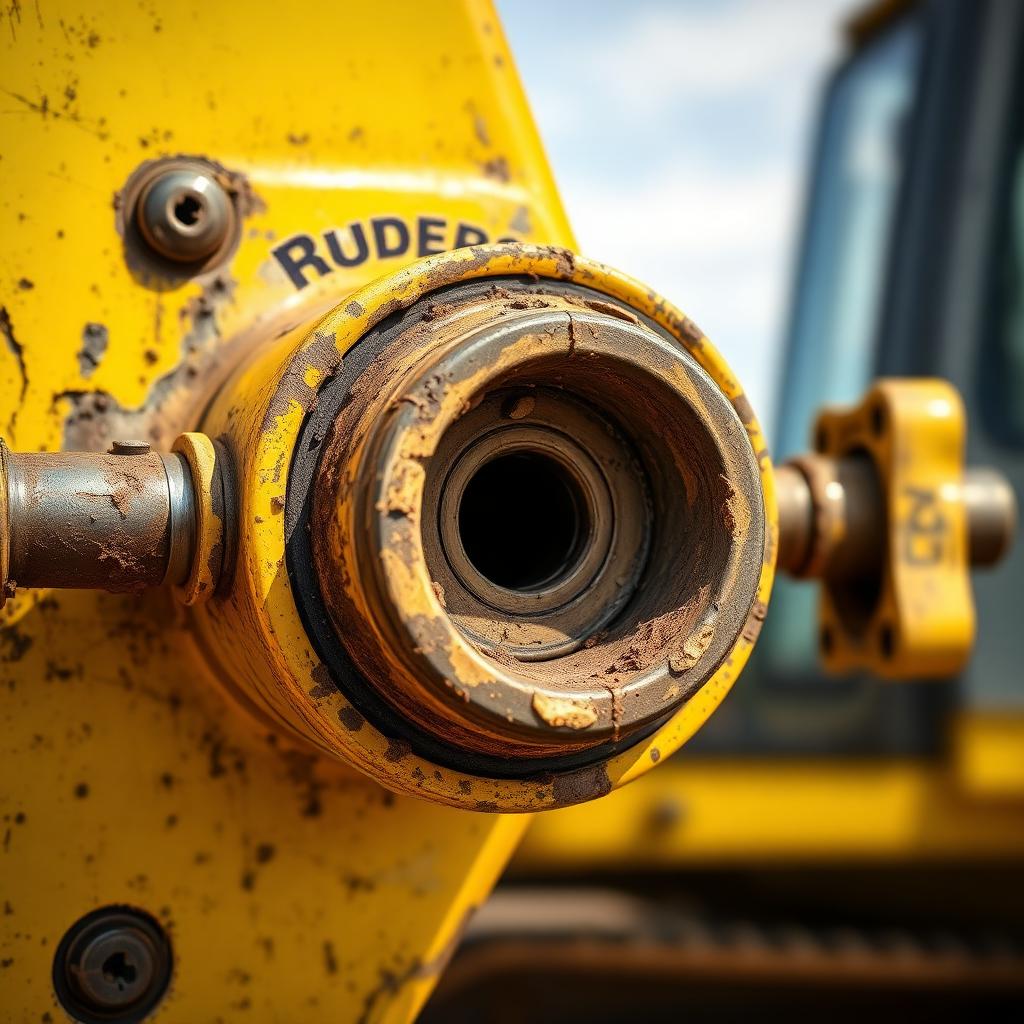
If your excavator boom has developed a clunk, your loader bucket wiggles side-to-side when you curl it, or grease keeps blowing past a pin within hours of pumping it, the pin bore is worn — and welding the pin will not fix it. The repair is line boring: machining the bore back to a clean, round, in-spec diameter and installing a properly-sized bushing or pin. Here is how to tell when your heavy equipment has crossed that line, and what the repair actually involves. This expands on our overview of mobile line boring.
What is actually wearing out
Every pivot on a piece of heavy equipment — boom-to-stick, stick-to-bucket, loader arm pins, cylinder ear mounts, hitch points — is a hardened steel pin riding in a bushing pressed into a bored hole in the casting or weldment. Three things wear:
- The pin itself (cheapest to replace)
- The bushing (next cheapest, but only worth it if the bore is still round)
- The bore in the casting or weldment (this is when line boring is the answer)
Once the bore is oval, oversize, or scored, no amount of new pins or bushings will hold for long. The bushing rotates in a sloppy hole, hammers itself out, and damages the bore further.
7 signs your heavy equipment needs line boring
1. Visible side-to-side play in a pinned joint
Park the machine, curl the bucket against the ground, and watch the pin joint. If the bucket or attachment rocks side-to-side under hydraulic pressure, the bore is worn, the bushing is worn, or both.
2. Clunks and bangs on direction changes
A sharp clunk when you reverse the direction of the boom, stick, or bucket is the pin slamming across the slop in a worn bore. Light clunks are wear; heavy clunks are a warning.
3. Grease will not stay in the joint
If you grease a pin and the grease blows out the side a few hours later, the bushing or bore has opened up enough that the seal cannot do its job. That accelerates the wear cycle.
4. Pin walking out of the joint
If you find the pin retainer bolts loose, the keeper bent, or the pin physically backing out, something in the joint is no longer holding the pin square. A worn bore lets the pin twist and walk.
5. New pins and bushings do not solve the problem
You installed a fresh kit, and within a few weeks the play is back. That is the bore telling you it is no longer round. New parts in an oval hole wear out fast.
6. Cracked weld at a pinned bracket
Worn bores misload the bracket and concentrate stress where the bore boss meets the structure. Recurring cracks at a bucket ear or boom pivot often trace back to a bore that has been allowed to wear too far.
7. Bucket or attachment does not track straight
If your bucket curls or your attachment moves in a noticeable arc when it should move in a straight plane, the bore wear has accumulated across multiple joints. That is when an operator starts to notice the machine feels "loose."
Why you cannot just weld the pin tighter
The most common field-shortcut is welding a bead on the pin or bushing OD to take up the slop. It does not work for long. The hardened pin gets compromised, the weld wears unevenly, and within a season the slop is back — often worse, because now the bore is scored. The proper fix is to weld the bore up to fill the worn area, then bore it back to a clean, round, on-spec diameter and install a correctly-sized bushing or pin. That is line boring. We cover the process step-by-step in our what is mobile line boring guide, and it overlaps with the general on-site heavy equipment repairs we do.
What gets line bored most often
- Excavator boom-to-stick and stick-to-bucket pins
- Excavator boom foot pins at the swing frame
- Wheel loader and skid steer loader arm pivots
- Bucket ear bores on loaders and skid steers
- Cylinder ear and rod-end mounts
- Backhoe boom and stick pivots
- Articulated dump truck and grader pivot points
- Heavy trailer and equipment hitch bores
Mobile versus shop line boring
Moving a 30-ton excavator to a shop costs lowboy time, escort fees, fuel, and several days of lost production. Mobile line boring brings the machining to the machine: the boring bar mounts directly to the equipment, the bore is welded and re-machined on-site, and in many cases the machine is back to work the same day. That is the whole reason our mobile welding and line boring service exists.
Repair, reinforce, or replace the boss
What is actually feasible depends on what we find on-site:
- Bore wear and ovality — measured before quoting
- Whether the bore boss has cracked or distorted
- Whether previous repairs left contaminated or hard weld metal that has to be removed
- Remaining wall thickness around the bore
- Bushing availability and sizing
- Manufacturer specifications when applicable
If the bore boss itself is cracked, distorted, or has insufficient material to bore back to spec, the right repair may involve a fabricated insert or boss replacement before the line boring step. We talk through that on-site rather than guessing over the phone.
When to call instead of waiting
Bore wear gets exponentially worse the longer you run on it. A bore that needs 0.060" of build-up today might need a full boss repair next season — and that is a much bigger job. If you have any two of the seven signs above, it is worth getting eyes on the joint before the next failure cascades into the surrounding structure. Recent on-site work is on the gallery.
What we will not pretend to do
We do not certify load ratings on machines we did not engineer. We do not promise every worn bore can be bored back to spec — sometimes the surrounding casting has too much damage. We will tell you straight when a repair is the right call and when the better answer is parts replacement or referring you to the dealer. For general industry context, OSHA's heavy equipment guidance covers operator safety expectations around worn or damaged equipment.
Service area
Based in East Bethel, MN. Mobile line boring and heavy equipment welding repair across Anoka County, Isanti County, Chisago County, and the Twin Cities north metro — including Blaine, Ham Lake, Andover, Forest Lake, Lino Lakes, Coon Rapids, Anoka, Ramsey, Elk River, Cambridge, and surrounding communities.
Get a quote for line boring or pin bore repair
Send a few photos — the machine, the joint in question, and a close-up of the pin or bore if you can pull the pin — plus a short note on what the joint is doing. Request a quote from Portable Precision Welding or call now.
Have a job like this in East Bethel, MN?